
Form 5472 Penalty Removal: Complete Guide to Reasonable Cause Abatement

Updated: Jun 29
Written and reviewed by Arik Rozen, CPA, MBA — Head of Tax Filing Department, Form5472.online | Virginia Board of Accountancy License #025991
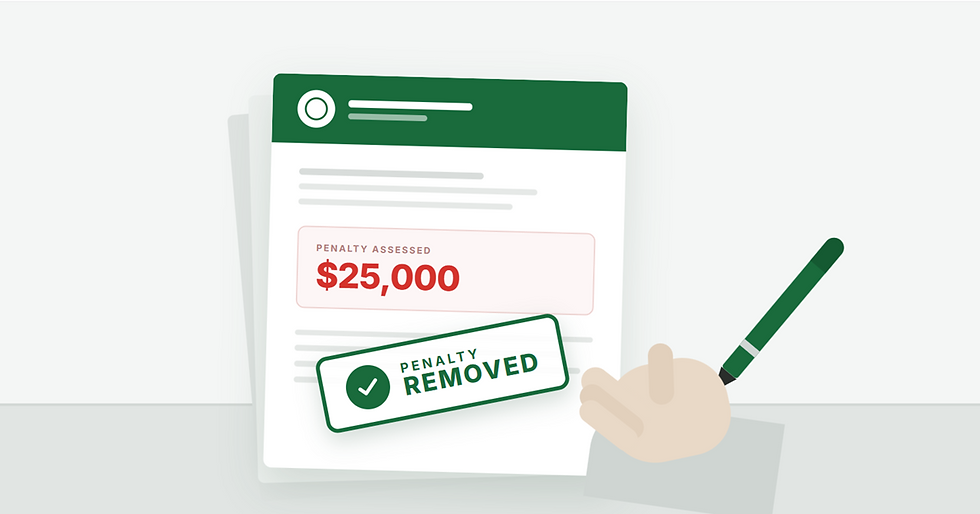
The $25,000 Penalty Is Automatic — But It Is Not Always Final
When the IRS assesses a $25,000 penalty for a late or missing Form 5472, most foreign LLC owners assume the penalty is permanent. It is not. The IRS has an established procedure for requesting full penalty abatement — and for foreign-owned LLC owners who meet specific criteria, that request is granted at a high rate.
This guide explains exactly how Form 5472 penalty removal works, what qualifies as Reasonable Cause, how First-Time Abatement differs, what DIIRSP procedures require, and why a CPA-drafted abatement letter significantly outperforms a self-drafted one.
Recent result: A client came to us after receiving an IRS penalty notice of $98,467.74 for multiple years of missed Form 5472 filings. We prepared the overdue returns, submitted them using DIIRSP procedures, and drafted a customized Reasonable Cause statement. Result: penalty reduced to $0. Case closed.
Why the IRS Assesses the Form 5472 Penalty
Under IRC §6038A(d)(1), the IRS assesses an automatic $25,000 penalty for each Form 5472 that is not filed, filed late, or substantially incomplete. The penalty is assessed per form, per year — meaning a foreign LLC owner who missed three years of filings and had two related parties faces potential exposure of $150,000 in penalties before any abatement is requested.
The penalty is automatic and does not require the IRS to prove that the non-filing was intentional. The burden is on the taxpayer to demonstrate that the failure was due to Reasonable Cause and not willful neglect.
What Is Reasonable Cause Under IRS Standards?
Reasonable Cause is a legal standard defined by the IRS as acting with ordinary business care and prudence but still being unable to comply with the filing requirement. This is not a subjective standard — the IRS evaluates Reasonable Cause claims against specific criteria established in Revenue Procedure 84-35, Treasury Regulation §301.6724-1, and IRS Policy Statement P-2-7.
The key principle is this: the taxpayer must show that the failure to file was not due to willful neglect, and that they made a genuine effort to comply once they became aware of the obligation.
The Five Scenarios the IRS Accepts for Form 5472 Reasonable Cause
1. Lack of Knowledge — Most Common for Foreign LLC Owners
The single most successful Reasonable Cause argument for foreign-owned LLC owners is lack of knowledge of the filing requirement. Prior to January 1, 2017, foreign-owned single-member LLCs classified as disregarded entities were not required to file Form 5472. The 2017 Tax Cuts and Jobs Act regulations dramatically expanded the filing requirement.
A non-resident owner who formed a U.S. LLC through an online formation platform in 2018 or later, and was never informed of the Form 5472 requirement by that platform or by a U.S. tax professional, has a strong Reasonable Cause argument based on lack of knowledge. The IRS has historically been receptive to this argument for foreign owners who can demonstrate they took reasonable steps to understand their U.S. tax obligations but were not informed of this specific requirement.
The Reasonable Cause letter must document precisely when the owner learned of the requirement, what steps they took to comply after learning of it, and why the failure to file earlier was not due to willful neglect.
2. Reliance on a Tax Professional
If a foreign LLC owner hired a U.S. tax professional — a CPA, an enrolled agent, or a formation service — who failed to inform them of the Form 5472 requirement, the owner may claim Reasonable Cause based on reliance on professional advice. This argument requires specific documentation:
Evidence that the taxpayer engaged a qualified professional for U.S. tax compliance
Evidence that the taxpayer provided the professional with all relevant information about their LLC ownership
Evidence that the professional failed to advise the taxpayer of the Form 5472 obligation
This is a strong argument but requires careful documentation. The IRS will scrutinize whether the professional was actually qualified to advise on international information returns, and whether the taxpayer provided complete information about their foreign ownership structure.
3. First-Time Abatement — The Fastest Route
First-Time Abatement (FTA) is a separate IRS program that provides automatic penalty relief for taxpayers who have a clean compliance history for the three years immediately preceding the penalty year. FTA is available under IRS Policy Statement P-2-7 and Revenue Procedure 2018-58.
Unlike Reasonable Cause, FTA does not require the taxpayer to prove why they failed to file. It requires only that the taxpayer:
Has filed all required returns for the three prior years (or filed valid extensions)
Has paid all taxes due for the three prior years (or arranged an installment agreement)
Has not been assessed a penalty in the three prior years
For foreign LLC owners who missed Form 5472 for the first time, FTA may provide faster and more reliable relief than a Reasonable Cause argument. However, FTA is limited to the first year of non-compliance — if the owner missed multiple years, FTA can only cover one year, and Reasonable Cause must be argued for the remaining years.
4. Death, Serious Illness, or Unavoidable Absence
The IRS accepts penalty abatement when the taxpayer — or a member of their immediate family — experienced a death, serious illness, or unavoidable absence that directly prevented timely filing. This argument requires medical or official documentation and a clear causal link between the event and the failure to file.
5. Systemic or Administrative Errors
Penalty abatement is also available when the failure to file was caused by factors outside the taxpayer's control — such as EIN issuance delays that prevented timely registration, IRS system errors, or mailing delays that caused late submission to the correct Ogden address. These arguments require documentary evidence of the specific error and its direct impact on the filing timeline.
DIIRSP — The Correct IRS Procedure for Voluntary Late Filers
The Delinquent International Information Return Submission Procedures (DIIRSP) is the IRS-approved method for filing overdue international information returns — including Form 5472 — outside of an existing IRS examination. Using DIIRSP correctly is critical because it distinguishes voluntary compliance from enforcement-triggered compliance, which the IRS treats very differently in penalty determinations.
Under DIIRSP, the taxpayer files the delinquent returns and attaches a statement explaining the reason for the late filing. This statement is the Reasonable Cause argument. Returns filed under DIIRSP with a properly prepared Reasonable Cause statement will not automatically be subject to the $25,000 penalty — the IRS reviews the statement and, if Reasonable Cause is established, waives the penalty.
Critical timing point: DIIRSP is only available for voluntary filers — taxpayers who are not currently under IRS examination for the relevant years. If the IRS has already opened an examination or issued a formal penalty notice, the DIIRSP procedure is no longer available and the abatement request must be made through a formal penalty abatement letter submitted in response to the notice.
What Happens If You Already Received an IRS Penalty Notice?
Receiving a CP15 or CP215 penalty notice from the IRS does not mean the penalty is final. The notice triggers a 60-day response window (extendable to 180 days for taxpayers outside the United States) during which you can submit a formal penalty abatement request.
The abatement request must include:
The delinquent Form 5472 and pro forma Form 1120 for all penalty years (if not already filed)
A written Reasonable Cause statement addressing the specific grounds for abatement
Supporting documentation for each ground claimed
A statement that the failure was not due to willful neglect
Acting within the response window gives the IRS the option to abate the penalty administratively — without requiring the taxpayer to go through a formal appeals process. Waiting beyond the response window significantly complicates the abatement process and may require IRS Appeals or Tax Court involvement.
90-day escalation: If non-compliance continues for more than 90 days after the IRS notice date, an additional $25,000 penalty is assessed for each 30-day period per form. For a client with three related parties and two missed years, failing to act within 90 days of the notice can add $270,000 in additional penalties on top of the original assessment.
Why a CPA-Drafted Reasonable Cause Letter Outperforms a Self-Drafted One
The Reasonable Cause argument is a legal and factual presentation to the IRS. The quality of the argument — how it is framed, what facts it emphasizes, what documentation it includes, and how it addresses the IRS's specific evaluation criteria — directly determines whether abatement is granted.
A self-drafted letter typically makes one of three common mistakes:
It states the conclusion without building the factual record — "I didn't know about Form 5472" is not a Reasonable Cause argument. "I am a non-resident of the United States who formed a Delaware LLC through [formation platform] in [year]. At no point did [formation platform] or any U.S. tax professional I engaged inform me of the Form 5472 filing requirement that applies to foreign-owned disregarded entities under Treasury Regulation §1.6038A-1(c)" — is.
It makes claims that are inconsistent with the documentary record — for example, claiming reliance on a tax professional when the taxpayer has no engagement letter or invoice from a professional
It fails to address the "willful neglect" standard — the IRS must conclude that the failure was not willful. A letter that does not affirmatively address this point leaves the determination to the IRS reviewer's discretion
A CPA-drafted letter builds the complete factual record, applies the correct legal standard, attaches the appropriate documentation, and frames the argument in the language the IRS expects to see in a successful abatement claim. The difference in outcome between a well-drafted and a poorly-drafted letter can be $25,000 per form per year.
Multi-Year Missed Filings — How the Strategy Changes
For taxpayers who missed Form 5472 for multiple years, the abatement strategy must address each year individually while building a coherent narrative across all years. The IRS will look for consistency in the Reasonable Cause argument — if you claim lack of knowledge for 2021 and 2022, but the record shows you engaged a U.S. tax professional in 2021, the argument for 2022 becomes significantly weaker.
The optimal strategy for multi-year cases typically combines:
First-Time Abatement for the earliest missed year (if the compliance history supports it)
Reasonable Cause for subsequent years based on the consistent circumstances that prevented compliance
A unified narrative that explains the entire period of non-compliance as a single continuous situation rather than a series of independent failures
Our 98% Success Rate — What It Means and What It Does Not
Form5472.online has achieved penalty removal for 98% of eligible clients. Eligibility is the key word. Not every client who contacts us qualifies for penalty abatement — and we will tell you clearly if your situation does not support a strong Reasonable Cause or FTA argument.
The cases that qualify most consistently are:
Foreign owners who formed their LLC through an online platform and were never informed of Form 5472
First-time non-filers with clean prior compliance histories
Owners who received incorrect or incomplete advice from a formation service or non-specialist accountant
Owners who discovered the requirement voluntarily and are filing before any IRS enforcement action
The cases that are more difficult — and where we will advise you honestly about your realistic prospects — include situations where the taxpayer was previously informed of the requirement, situations where the record suggests awareness of the obligation, and situations where significant time has passed since receiving an IRS notice without action.
How Our Penalty Removal Process Works
Every penalty removal engagement at Form5472.online follows the same structured process:
Initial case review — your CPA reviews your specific situation and advises whether Reasonable Cause or FTA provides the stronger argument
Documentation gathering — we identify what documentation is needed to support your specific argument and request it through the client portal
Return preparation — we prepare the delinquent Form 5472 and pro forma Form 1120 for all penalty years
Reasonable Cause letter drafting — your assigned CPA writes a customized abatement letter based on your specific facts, citing the correct legal standards and attaching all supporting documentation
Coordinated submission — the delinquent returns and abatement request are submitted together to the IRS using DIIRSP procedures (for voluntary filers) or as a formal penalty response (for clients who have received notices)
IRS monitoring — we monitor the IRS response and handle all follow-up correspondence until the case is resolved
For a complete guide to Form 5472 filing requirements, deadlines, and penalty information, read our comprehensive guide: form5472.online/post/form-5472-comprehensive-guide-foreign-owned-llc
Arik Rozen, CPA, MBA is a U.S. Certified Public Accountant licensed by the Virginia Board of Accountancy (License #025991) since September 2001. He leads the tax filing department at Form5472.online, part of TAXUSA GROUP, registered in Brooklyn, NY 11230. Every tax return and Reasonable Cause statement filed through Form5472.online is prepared by our licensed CPA team and reviewed and signed under his CPA license.


Comments